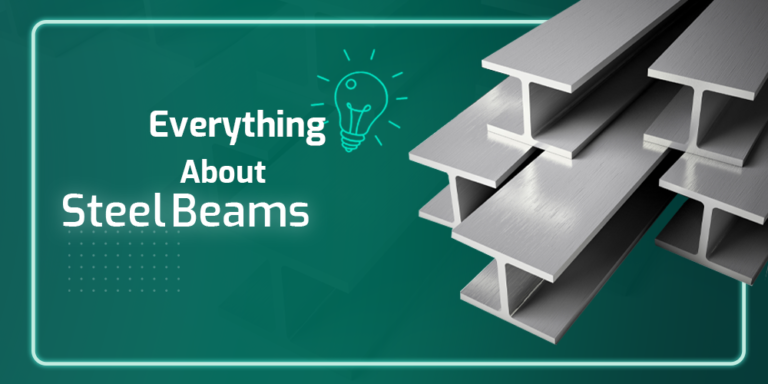


Specialized Guide to I-Beam Production
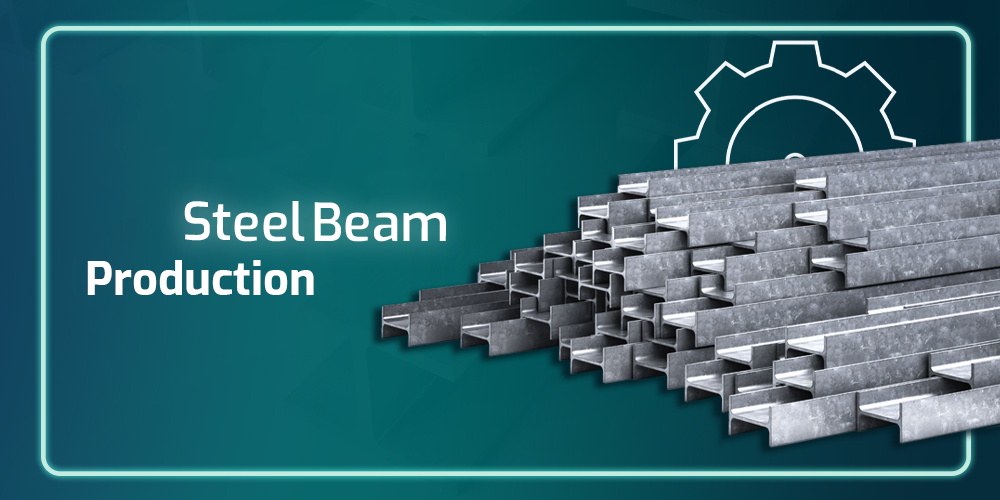


Specialized Guide to I-Beam Production: From Chemical Composition to Final Quality Control
Introduction
The I-beam is a key element in metal frameworks, playing an indispensable role in modern construction due to its excellent mechanical properties. Beyond bearing loads, this steel section efficiently transfers compressive, tensile, and bending forces. To fully understand its performance, the production process must be examined from start to finish.
⸻
Initial Chemical Composition
For producing I-beams, steel billets must have appropriate quality. A typical composition for ST37 or ST52 I-beams includes:
-
Carbon: 0.17–0.22%
-
Manganese: 0.5–1%
-
Silicon: 0.3–0.5%
-
Phosphorus and Sulfur: maximum 0.05%
⸻
I-Beam Production Process
Charging and Preheating Billets
Steel billets are heated in direct flame furnaces to around 1150–1250°C. Precise temperature control at this stage is crucial for structural uniformity.
Primary Rolling (Rodding)
Billets pass through initial rolling stands, transforming into flat or rectangular sections, gradually shaping them for further forming.
Intermediate Rolling and Shaping
In this stage, the initial section gradually enters specialized I or H-shaped molds. With each pass through the stand, the beam’s shape becomes more defined.
Final Rolling (Finishing Stand)
At the line’s end, I-beam dimensions—including web thickness, flange width, and flange parallelism—are adjusted. Concentricity and dimensional accuracy are critical at this stage.
Hot Cutting and Cooling
Produced I-beams are cut to standard lengths (6 or 12 meters) using industrial guillotines. They are then placed on cooling beds to naturally solidify.
Quality Control Tests
The final product undergoes evaluations such as tensile, bending, impact tests, chemical analysis, and dimensional inspection. Factory name, size, and heat code are also stamped on the web.
⸻
Types of I-Beams
-
IPE: European standard with parallel flanges, widely used in Iran
-
INP: Russian and Chinese standard with tapered flanges
-
IPB (HEB): Wide-flange I-beams for columns and heavy loads
-
Cellular I-beams: Web contains openings to reduce weight and allow service passage
⸻
Mechanical Specifications of ST37 I-Beams
-
Tensile strength: 370–510 MPa
-
Yield strength: minimum 235 MPa
-
Elongation: minimum 20%
-
Surface hardness: approximately HB 120–160
⸻
Leading I-Beam Manufacturers in Iran
-
Zob Ahan Isfahan: Main producer with over 3 million tons per year
-
Foulad Alborz Iranian (Faico): Produces IPE and INP at industrial scales
-
Nourd Aryan Foolad: Focus on medium and light I-beams
-
Foulad Yazd and Shekofteh Mashhad: Light construction I-beams
⸻
Conclusion
The production of I-beams combines metallurgical engineering, thermal technology, and precise quality control. Though seemingly simple, I-beams play a complex role in structural stability. Correct selection of type, standard, and manufacturer ensures durability, safety, and economic efficiency in construction projects.