

Comprehensive Guide to Angles and Channels: The Hidden Pillars of Industrial Structures


A Comprehensive Guide to Angles and Channels: The Hidden Pillars of Industrial Structures
Introduction
In the world of construction and metal industries, some materials, despite their simple appearance, play a crucial role in the strength and cohesion of structures. Angles and channels are among these materials, widely used in construction, industrial projects, and even machinery. A precise understanding of these steel sections is essential for making cost-effective and correct choices.
What is an Angle?
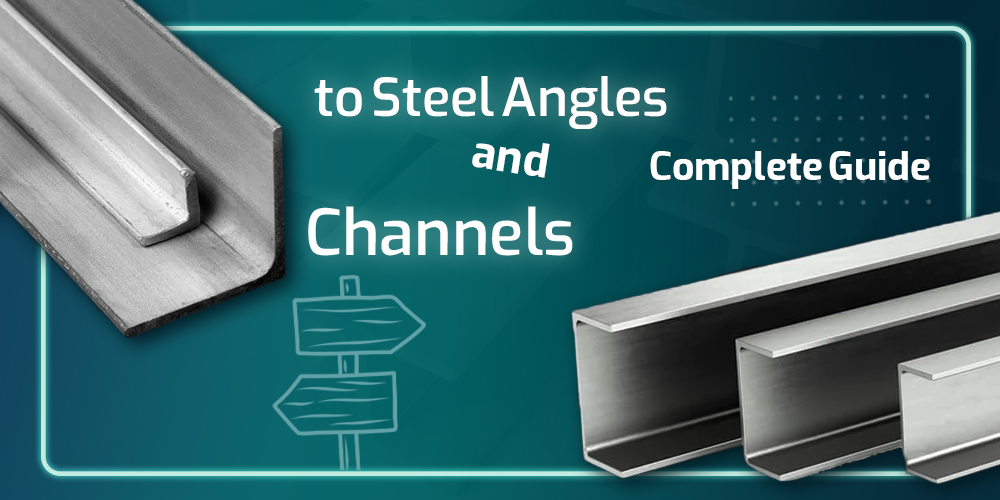
An angle bar (Angle) is a steel section shaped like the letter “L,” consisting of two perpendicular legs, commonly represented by the symbol “L” in engineering drawings.
Types of Angles by Shape:
-
Equal-leg angle: Both legs are of equal length (e.g., 40×40 mm).
-
Unequal-leg angle: One leg is longer than the other (e.g., 50×30 mm).
Types of Angles by Production Method:
-
Rolled angle: Produced directly from hot-rolled steel billets.
-
Pressed angle: Made by bending a steel sheet at a 90° angle.
Applications of Angles:
-
Reinforcing corners of structures
-
Connections for beams and girders
-
Construction of metal shelves and supports
-
Elevator systems and metal frameworks
What is a Channel?
A channel bar (Channel) is a U-shaped steel section with a web and two parallel flanges. Due to its geometric form, it provides good strength against compressive and shear forces.
Types of Channels by Shape:
-
Plain channel: Straight, angled flanges (commonly used in Iran)
-
Perforated channel: Flanges with holes for specific industrial applications and towers
Types of Channels by Production Method:
-
Rolled channel: Directly produced from steel billets.
-
Pressed channel: Formed by bending steel sheets.
Standards for Channel Production:
-
DIN 1026
-
EN 10279
-
ASTM C3
Applications of Channels:
-
Light beams and columns
-
Industrial doors and window frames
-
Construction of machinery and industrial equipment
-
Cable trays and greenhouse frames
Differences Between Angles and Channels
| Feature | Angle | Channel |
|---|---|---|
| Shape | L | U |
| Best resistance | Corners and edges | Flat surfaces and longitudinal support |
| Main application | Connecting and reinforcing corners | Load-bearing and force transfer |
Important Tips for Purchasing Angles and Channels
-
Steel grade: Choose ST37 or ST52 depending on structural requirements.
-
Production standards: Consider DIN or national standards.
-
Accurate dimensions: Ensure length, thickness, and flange sizes match design drawings.
-
Manufacturer: Reputable brands such as Foolad Nab Tabriz, Zob Ahan Isfahan, Shekofteh Mashhad, and Profile Tehran.
Conclusion
Angles and channels are fundamental elements in construction, industrial, and metal industries. Despite their simple shapes, they have wide and essential applications. Correct selection ensures durability, safety, and structural stability. When purchasing, checking standards, technical specifications, and production quality is crucial to reduce future costs and risks.