

Comprehensive and Technical Review of the Causes of Rebar Corrosion in Concrete


Introduction
Reinforced concrete structures are among the most widely used and economical construction systems in the world. The combination of concrete, as a compressive material, with steel rebar, as a tensile element, offers significant advantages. However, one of the most serious and costly challenges in such structures is the corrosion of reinforcing steel inside the concrete.
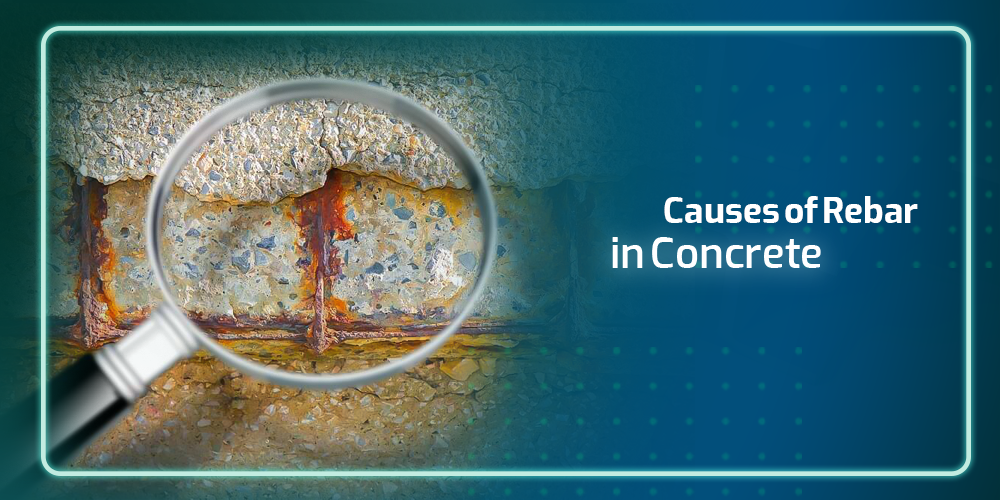
Rebar corrosion not only reduces the structural strength, but also leads to cracking, spalling, delamination of concrete, and even complete structural failure over time. This article provides a comprehensive overview of the corrosion mechanism, influencing factors, types of corrosion, environmental conditions, and modern prevention and repair methods.
1. Definition of Rebar Corrosion in Concrete
Rebar corrosion refers to the chemical reaction between steel and aggressive agents present inside the concrete or the surrounding environment. This reaction produces iron oxides (rust), leading to expansion of the steel, which in turn creates internal pressure on the concrete, causing cracking and delamination.
Under normal conditions, concrete has a highly alkaline environment with a pH of approximately 12.5 to 13.5. This alkalinity forms a protective passive layer on the surface of the steel, which prevents corrosion. However, if this alkalinity is reduced or aggressive ions reach the steel, the protective layer breaks down, initiating corrosion.
2. Types of Rebar Corrosion
2.1. Uniform Corrosion
The surface of the rebar corrodes uniformly. This type is commonly caused by carbonation of concrete and progresses slowly.
2.2. Pitting Corrosion
Corrosion occurs at localized spots, typically due to chloride ions. This type is more dangerous because it may not show visible signs while penetrating deeply.
2.3. Galvanic Corrosion
When two dissimilar metals (e.g., carbon steel and stainless steel) are in contact with each other and an electrolyte (moist concrete), the less noble metal corrodes faster.
2.4. Stress Corrosion
A combination of tensile stress and corrosive environment leads to fine, progressive cracking of the rebar.
3. Factors Affecting Rebar Corrosion in Concrete
3.1. Chloride Ion Penetration (Cl⁻)
Sources: de-icing salts, marine environments, contaminated admixtures.
Chlorides directly attack and destroy the steel’s passive layer.
3.2. Carbonation of Concrete
CO₂ from air enters the concrete, reacts with Ca(OH)₂, and reduces the pH to below 9, destroying the protective layer.
3.3. Presence of Cracks in Concrete
Cracks create direct pathways for water, oxygen, CO₂, and chlorides.
3.4. High Water-to-Cement Ratio (w/c)
Higher w/c increases porosity and permeability, facilitating the access of corrosive agents to the steel.
3.5. Insufficient Concrete Cover
If concrete cover is below standard, the structure becomes more vulnerable to penetration.
3.6. Environmental Conditions
Coastal, industrial, or highly humid areas exhibit the highest corrosion rates.
4. Electrochemical Mechanism of Rebar Corrosion
Rebar corrosion is an electrochemical reaction involving two half-reactions:
Anodic Reaction (Oxidation):
Fe → Fe²⁺ + 2e⁻
Steel loses electrons and forms iron ions.
Cathodic Reaction (Reduction):
O₂ + 2H₂O + 4e⁻ → 4OH⁻
Oxygen in the presence of water reacts with electrons to form hydroxide ions.
This process continues with the formation of rust, increasing the steel’s volume.
5. Effects of Corrosion on the Structure
• Longitudinal and transverse cracks
• Surface spalling
• Reduced bond between concrete and rebar
• Decreased tensile strength of steel
• Increased risk of sudden structural failure
6. Corrosion Prevention Methods
6.1. Proper Design and Dense, Low-Permeability Concrete
• Water-to-cement ratio below 0.5
• Adequate vibration
• Concrete cover according to codes (3–7 cm depending on exposure)
6.2. Specialized or Coated Rebar
• Epoxy-coated rebar
• Galvanized rebar
• Stainless steel rebar
• FRP rebar
6.3. Corrosion-Inhibiting Admixtures
Such as calcium nitrite, sodium nitrite, and migrating corrosion inhibitors.
6.4. Pozzolanic or Microsilica Concrete
Reduces porosity and improves resistance to ion penetration.
6.5. Surface Coatings and Crack Repair
Using sealers, penetrating gels, resins, or injection systems.
7. Corrosion Detection and Monitoring Methods
• Non-destructive tests:
– Half-cell potential
– Concrete electrical resistivity
– Linear polarization resistance
• Repair methods:
– Removal of damaged areas
– Replacement of concrete and corroded rebar
– Sacrificial anodes or cathodic protection
Conclusion
Rebar corrosion in concrete is a hidden but very serious threat to the safety and durability of reinforced concrete structures. Combating it requires precise knowledge of environmental conditions, materials, engineering design, and proper maintenance. Although corrosion cannot be eliminated entirely, a combination of preventive measures, quality materials, and intelligent maintenance can significantly extend the service life of a structure.