

Comparison of structure, properties, and applications in industry and engineering


Comparison of Structure, Properties, and Applications in Industry and Engineering
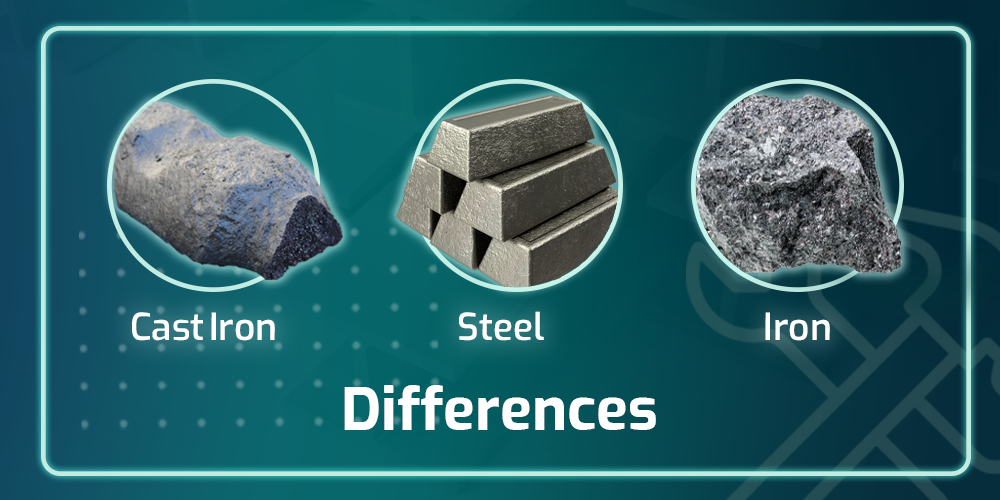
In the world of metals, the names cast iron, iron, and steel are widely used, yet many people are not aware of their real differences. Although all three materials are iron-based, variations in chemical composition, production processes, and mechanical properties have made each of them suitable for specific industrial applications.
In this article, we clearly and accurately explain the differences among these three materials.
1. Basic Definitions
Iron
-
A chemical element with the symbol Fe
-
The base material for producing steel and cast iron
-
Rarely found in pure form in nature, usually extracted from iron ore as pig iron
Steel
-
An alloy of iron plus a small percentage of carbon (0.1 to 1.7%)
-
Strong, flexible, weldable, and widely used in construction and industry
Cast Iron
-
An alloy of iron with a high carbon percentage (more than 2%)
-
Hard, brittle, non-weldable, and suitable for cast products
2. Differences in Chemical Composition
-
Pure iron contains almost no carbon and lacks additional alloying elements.
-
Steel contains 0.1–1.7% carbon along with alloying elements such as manganese, chromium, nickel, and molybdenum.
-
Cast iron contains more than 2% carbon along with silicon, manganese, phosphorus, and sulfur.
3. Differences in Physical and Mechanical Properties
-
Hardness:
-
Pure iron: low
-
Steel: medium to high
-
Cast iron: high
-
-
Tensile strength:
-
Pure iron: low
-
Steel: high
-
Cast iron: moderate
-
-
Weldability:
-
Pure iron: poor
-
Steel: excellent
-
Cast iron: weak or impossible
-
-
Ductility:
-
Pure iron: high
-
Steel: high
-
Cast iron: low
-
-
Impact resistance:
-
Pure iron: low
-
Steel: high
-
Cast iron: very low (brittle)
-
-
Cost:
-
Pure iron: low
-
Steel: medium
-
Cast iron: low
-
4. Applications
Cast Iron:
-
Cast parts (pump housings, engine cylinders, gear housings)
-
Manhole covers, machine bases, gas stoves
Steel:
-
Building frameworks, automobiles, rails, bridges, pressure pipes
-
Tools, beams, rebar, industrial tanks
Pig Iron (raw iron):
-
Mainly used as the base material for producing steel and cast iron
-
Has limited direct industrial applications
5. Production and Forming Processes
-
Cast Iron: Produced by melting and direct casting; due to brittleness, it cannot be forged or rolled.
-
Steel: Produced by reducing the carbon content of pig iron; can be rolled, forged, machined, and welded.
-
Pig Iron: Obtained from iron ore in blast furnaces and used as the base for other alloys.
6. Which Material Should Be Chosen?
-
Building frameworks → Steel
Reason: High strength, weldability, and ductility -
Precise cast components → Cast iron
Reason: High fluidity in molds and good compressive strength -
Industrial tools → Alloy steel
Reason: High hardness, wear resistance, and machinability -
Low-cost equipment → Cast iron or pig iron
Reason: Low cost and fast production
Conclusion
Although cast iron, steel, and pure iron all belong to the iron family, differences in composition and manufacturing processes make them suitable for very different applications. Steel strikes a balance between hardness and flexibility, cast iron is ideal for rigid, cast components, and pig iron is the raw material used to produce both. Choosing the right material forms the foundation of every successful industrial or construction project.