

Analysis of Fire Incidents in Steel Buildings: Lessons from Iran and Around the World


Introduction
Steel structures have become one of the primary choices in modern construction due to their fast installation, high strength, and ability to cover large spans. However, steel has an inherent weakness when exposed to fire. Although steel does not burn, its strength and load-bearing capacity decrease sharply as temperature rises, which can ultimately lead to structural collapse.
Vulnerability of Steel to Fire
-
At around 500–600°C, the strength of steel decreases by up to 50%.
-
At 1000°C, steel becomes almost soft, and the structure may collapse.
-
Rising temperatures lead to a significant drop in modulus of elasticity, thermal creep, and buckling of steel members.
Global Examples of Fire Incidents in Steel Structures
Twin Towers – New York (September 11, 2001)
-
Jet fuel raised the temperature of steel to over 900°C.
-
The upper steel structure experienced severe weakening, leading to progressive collapse.
-
This incident resulted in major revisions in fire-resistant design standards worldwide.
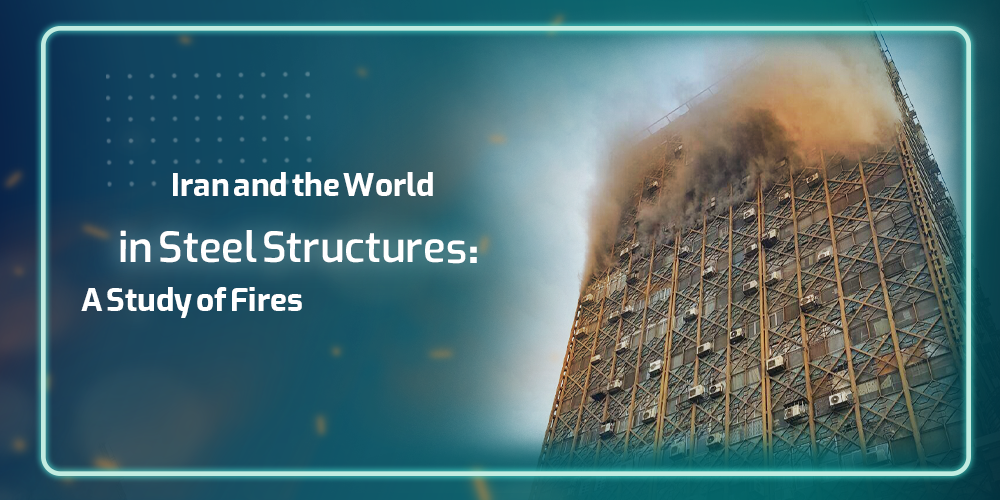
Plasco Building – Tehran (2017)
-
A fire on the lower floors of a 17-story commercial building with a steel frame.
-
Insufficient fire resistance of steel connections.
-
Lack of adequate fireproofing and unsuccessful fire suppression.
-
Resulted in complete structural collapse and the loss of 16 firefighters.
Windsor Tower – Madrid (2005)
-
A 32-story building with a composite steel–concrete structure.
-
A major fire spread through the upper floors.
-
Portions of the steel structure collapsed, while concrete columns showed higher resistance.
Address Hotel – Dubai (2015)
-
A large New Year’s Eve fire.
-
Despite rapid fire spread, the steel frame did not collapse due to high-quality fireproof coatings and engineered fire-resistant design.
Factors That Exacerbate Fire Damage in Steel Structures
-
Lack of fireproof coatings
-
Weaknesses in heat-resistant connection design
-
Poor separation of electrical/flammable systems
-
Human error in maintenance and inspection
-
High thermal conductivity of steel
Methods to Improve Fire Safety in Steel Structures
Passive Fire Protection
-
Spray-applied materials, rock wool, intumescent coatings
-
Increases thermal resistance of steel members to 2 hours or more
Performance-Based Fire Design
-
Using thermal simulation and fire scenario modelling
-
Predicting behavior of critical structural members under heat
Strengthening Steel Connections
-
Designing welds and bolts with reduced strength at high temperatures in mind
Active Fire Detection and Suppression Systems
-
Sprinklers
-
Smoke and gas detectors
-
Improved access for firefighting operations
Iran’s Experience: Lessons from the Plasco Incident
The Plasco disaster marked a turning point in fire safety standards in Iran. Key contributing factors included:
-
Lack of proper fireproofing on beams and columns
-
Absence of automatic suppression systems
-
Building deterioration and insufficient inspections
-
Delays in evacuation and non-compliance with fire safety protocols
This event led to major revisions in the Iran National Building Regulations, particularly Section H (Topic 3: Fire Safety of Buildings).
Conclusion
Despite their many advantages, steel structures are vulnerable to fire. Global and domestic case studies show that intelligent design, accurate execution, and proper fire protection systems significantly reduce the risk of catastrophic damage.
Fire safety in structural design should not be seen as an additional cost, but rather as an investment in human life, long-term structural performance, and overall safety.