

A Technical Guide to Steel Billet Production: The Foundation of Metalworking Industries


Steel Billet: A Scientific and Practical Overview of Its Role in Metalworking Industries
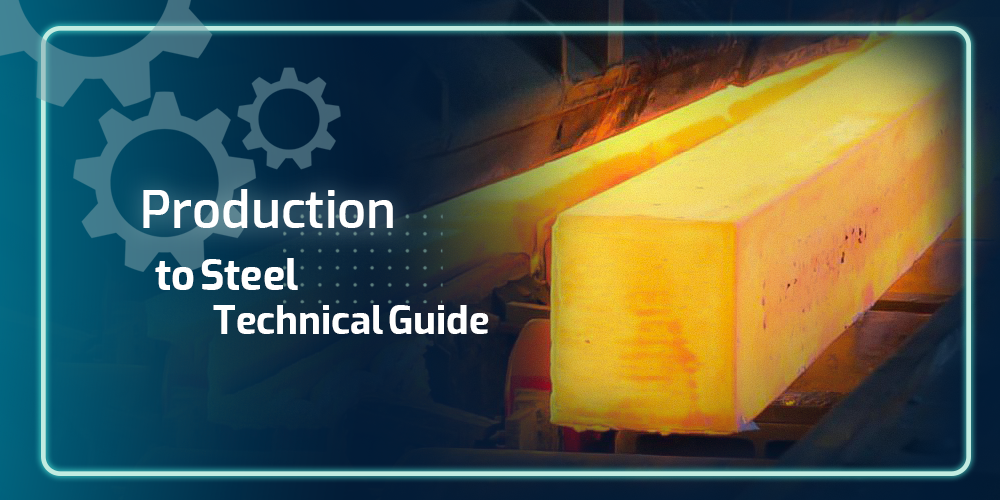
Steel billet (Steel Billet, Bloom, or Slab) is one of the semi-finished products in the steelmaking process and serves as the raw material for producing various steel sections such as rebar, I-beam, angle, sheet, and pipe. The quality of the billet has a direct effect on the mechanical and physical properties of the final product. Therefore, understanding billet production methods, alloy composition, quality control, and its types is essential for professionals in this field.
What Is a Steel Billet?
A steel billet is a solid metal piece typically cast in cubic (Billet), rectangular (Bloom), or flat (Slab) shapes and used as the primary material in rolling or extrusion processes. The dimensions and type of billet depend on the final product and its production method.
Types of Steel Billets Based on Shape and Size
| Type | Specifications | Applications |
|---|---|---|
| Billet | Square section with a width under 15 cm | Rebar, wire rod, wire, pipe |
| Bloom | Large square or rectangular section | I-beam, channel, rail |
| Slab | Flat and wide section with low thickness | Steel sheet, coil, flat profiles |
Steel Billet Production Methods
1. Blast Furnace (BF) + Basic Oxygen Furnace (BOF)
The traditional method that uses iron ore, coke, and limestone in a blast furnace.
Steps:
Melting iron ore → producing molten pig iron → transferring to BOF → injecting oxygen → steelmaking → casting in molds
Advantages: High production capacity, suitable for mass production
Disadvantages: High energy consumption, significant environmental pollution
2. Direct Reduction (DRI) + Electric Arc Furnace (EAF)
Uses sponge iron or scrap metal as the main input. Very common in Iran.
Steps:
Direct reduction → sponge iron → melting in EAF → secondary refining & alloying → casting
Advantages: Lower energy consumption, better chemical control
Disadvantages: Lower capacity, dependence on electricity
Steel Billet Casting Process
Melting & Alloying
Raw materials are turned into molten steel and alloying elements such as Mn, Si, Cr, V, etc. are added.
Continuous Casting (CCM)
The most common method: molten steel enters a copper mold and solidifies continuously, then is water- or gas-cooled.
Cutting & Packaging
Solidified billets are cut to standard lengths (6 or 12 meters) using torches or industrial shears.
Chemical & Mechanical Specifications
| Steel Grade | C (%) | Mn (%) | Si (%) | Application |
|---|---|---|---|---|
| ST37 | 0.17 | 0.5–1.0 | 0.2 | Construction rebars |
| ST52 | 0.22 | 1.3 | 0.4 | Heavy structures |
| CK45 | 0.45 | 0.7 | 0.3 | Industrial parts, shafts |
Quality Control in Billet Production
-
Chemical analysis (OES)
-
Ultrasonic test for internal cracks
-
Surface inspection for defects
-
Standards: ASTM A29, DIN 1013, ISIRI 14704
Major Steel Billet Producers in Iran
-
Mobarakeh Steel
-
Khouzestan Steel
-
Esfahan Steel Company
-
Saba Steel Complex
-
Kaveh South Kish Steel
-
Hormozgan Steel
Final Applications of Steel Billet
-
Rebar production
-
I-beam, angle, channel
-
Sheet & coil production
-
Pipes, profiles, rails
-
Automotive, tools, petrochemical industries
Conclusion
Steel billets are the first step in the production chain of steel products. Correct production methods, precise chemical control, and adherence to standards improve product quality and performance. Understanding melting, casting, and quality control processes helps professionals maintain a competitive advantage in the steel industry.